Showing posts with label lawn mower blades. Show all posts

Monday, 22 May 2017

Replacement Blades for Flymo, Gardena, and Husqvarna Automower Models

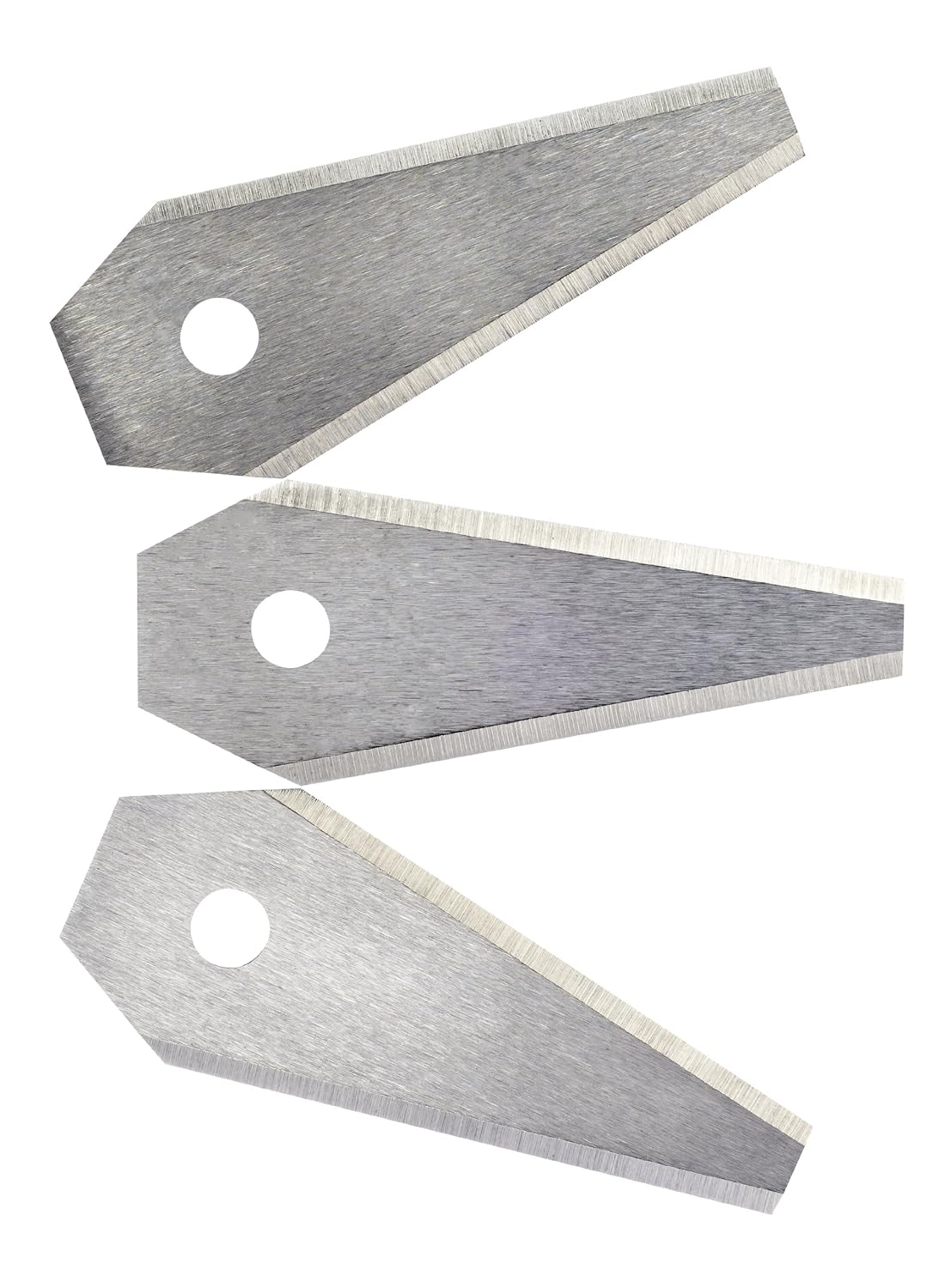
Robotic lawn mowers are great, but they, like all mowers, have parts that wear out. As a result of their design, Husqvarna Automower based machines seem to need their blades replacing quite often.

Part of the issue is that they are smaller, lighter, and designed more for fine cutting than longevity. All it needs is a few errant branches and you will find that you need to buy replacement blades several times per season.


Original Blades Aren't Cheap


If you can find them, Flymo 1200r replacement blades (pack of 9) will set you back over £25. That's almost 30 Euros, and at that price, the compatible Gardena R40Li blade pack of 9 at 18.99 Euros begins to look tempting: all you'd need to do is hop over the Channel!

However, even these pale next to aftermarket blades available on Amazon.

For example, for less than £15 (excluding delivery), you can buy the pack on the right: 30 compatible blades, plus bolts, for all Husqvarna Automower models.

The seller is so confident that these are going to be a perfect drop-in replacement that they offer a refund if they don't. I would advise reading the small print, but there's also the suggestion that they would honour a refund even if you open the packet.

But wait! There's more.

From the same supplier, there's another pack of 30, seemingly supplied without screws (bolts), but with a rather fetching titanium coating, at an even lower price.

Now, I take pretty good care of my bolts, and it's fair to say that whenever I've replaced the blades, I've managed to stockpile quite a few of them over the past few seasons.

They're slightly special, as owners of any of these models will know, in that they have a kind of thread-less, slightly oversized shoulder, just underneath the bolt's head, which allows the blade to rotate freely.

So, if you haven't managed to hold on to them, it's worth keeping a note that next time you should do so, if only to give you access to the cheaper range of aftermarket blades.

Again, read the small print, but the manufacturer seems pretty confident that either pack will prove a decent replacement for the originals.

SourceBlade PricePack
Flymo£2.709 + bolts
Gardena(£1.82)9 + bolts
Genisys£0.4830 + bolts
Genisys Titan£0.4330 blades only

It's also worth noting that Genisys also has a range of blades and accessories for all the popular makes, including the Bosch Indego, Worx Landroid, and Honda Miimo. If you go through their online catalogue at Amazon, you'll also find smaller sized  packs of blades so you can test out a cheaper pack before you commit.

See the whole range of robot mower spares from Genisys by clicking the link.

Tuesday, 8 October 2013

What Are the Differences Between the Major Robotic Lawn Mower Brands

Most robotic lawnmowers operate on the same basic principles with the same key features:

  • mulching blades (small amount of grass cut, drops onto the lawn)
  • powerful wheels (to deal with slopes)
  • sensors (to avoid obstacles)
  • guide wire (to keep within one or more zones)

However, within these principles there is scope for quite a lot of variation, and some of the variations serve to differentiate the models on offer.

Of course, as always, one of the biggest differentiating factors is price. Across the ranges, prices can triple, so it's worth knowing what you are (potentially) getting for your money.

Different Blades

Underneath any lawn mower, be it a Flymo hovering mower, or a Briggs and Stratton powered petrol guzzling traditional push around mower, there are one or more blades.

Traditional mowers are built to cut through long grass that has either been neglected over the off-season, or needs cutting every week (and only gets cut once a week) with the clippings being taken off to be disposed of.

Robotic mowers are designed for one purpose - to cut automatically and regularly, and drop the grass tips down onto the lawn to mulch it; automatically providing nutrition as well as keeping the lawn trim.


Most of the mowers on the market have multiple blades, held in place by a screw, which spin around at great speed, clipping the tips of the grass, and then chopping those tips into a fine dust.

Above right, are the blades for a Bosch Indego mower, which are long and thin.

To the left are the blades from a Gardena / Husqvarna, and Flymo mower, all of which seem to be either manufactured by Husqvarna in different liveries, or made under license.

Then, there are the single blade varieties, such as those used by RoboMow models, as pictured on the right.

So, which is the best?

Naturally, each manufacturer will have their reasons, but from the point of view of the mulching process, I have an idea that the loose blades might provide a better cutting action.

However, they are also more likely to snap (it's happened twice on my Gardena/Husqvarna) and fall off. I have a sneaking suspicion that the single piece blades are less likely to fail, but more likely to do damage should they come off.

Different Wheels

There are really only two choices for wheel arrangements - thee or four wheels - but again there is a surprising amount of variety across brands. Originally, Husqvarna went with a three wheel model, with the rear single wheel being smaller, and on a pivot.

This is very similar to the Flymo wheel arrangement, pictured on the left.

It has been replaced in more recent models with a version that has the smaller wheel at the front, like the Bosch Indego, and which, like the Bosch also enters the charging station front-first as opposed to back-first like the smaller Flymo models

Different Control Styles

All mowers need to have sensors to avoid hitting obstacles (like dogs, cats or trees!) and these are usually in the form of bumpers. Bumpers are reliable in a way that, for example, an ultrasound sensor might not be.

Next to the bumpers are different remote control styles - some mowers have a control pad that lets the owner steer the mower from zone to zone, while most just take themselves to a new zone by following a guide wire.

The guide wire is accompanied by a perimeter wire, which restricts the mower to the current zone. Many manufacturers also sell a kit to add new zones, so that the mower can be used on a greater area than originally installed.

Finally, some more recent models are starting to use GPS (Global Positioning System) antennas to help map out the space that needs to be mowed, and also to make sure that the whole area has been cut.

This last is important because, like some robotic vacuum cleaners, most of the models on the market tend to mow in a random fashion, over an extended period of time, and use this to make sure that the whole lawn has been cut.

Some of the more expensive models also have other cutting modes, so that they can be adapted to different shapes of lawn. So, if you have a lawn that is (a) large and (b) has many obstacles as well as (c) being an odd shape, it's probably worth spending a bit extra to get a more clever mower.

One last differentiating factor is the charging station. While most manufacturers have spotted that this needs to be weatherproof and located outside, some of the cheaper models still have an indoor charging station and require the mower to be carried or driven from the garage to the lawn.

Clearly, in the interests of automatic mowing, and ease of use, an outdoor charging station is the way to go.

Armed with this rundown of the various different features of automatic robotic lawn mowers, you should now be ready to choose from the models on the market, and join the rest of us who can sit back and watch whilst our lawns are carefully and immaculately mowed!